
Elon Musk says you can photograph your credit card and let Grok Bot do your shopping. Grok’s own terms say something very different about who pays when the agent gets it wrong. Here’s the gap, and why every firm owner should read the fine print before handing an AI agent any authority.
What is an AI agent?
An AI agent is software that doesn’t just answer questions. It takes actions on your behalf: browsing websites, sending messages, filling in forms and, increasingly, making purchases with your payment details.
That difference matters. When a chatbot gives you a wrong answer, you can ignore it. When an agent places a wrong order, the money has already moved. So the question isn’t only “how smart is the agent?” It’s “when it gets something wrong, who pays?”
Whether you run an accounting firm, a law practice or another small business, the answer sits in a document most people never open: the terms of service.
What Musk is saying
Most of us learned one rule about credit cards early: keep it in your wallet, and never send a picture of it to anyone.
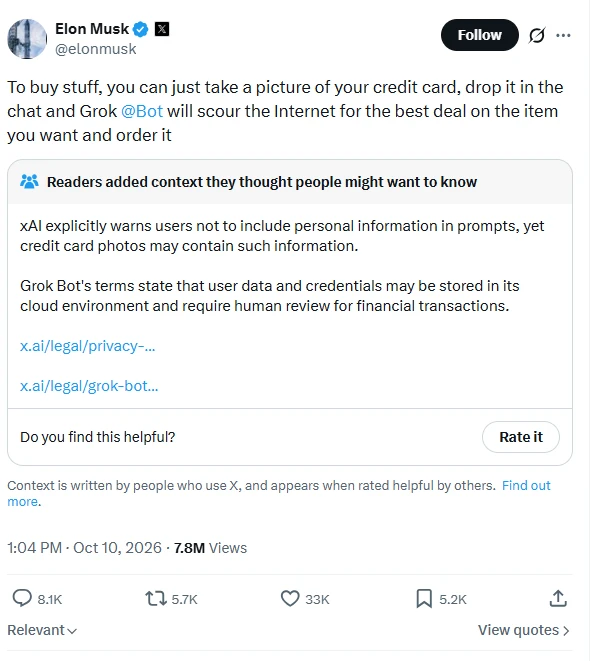
On October 10, Elon Musk suggested the opposite. In a post viewed nearly 8 million times, he told people they could photograph their credit card, drop it into a chat, and let Grok Bot find the best deal and order it. X readers soon attached a context note saying xAI itself warns users not to include personal information in prompts, and a card photo contains exactly that.
It wasn’t the first time. In August, a user said he was thinking of connecting Grok Bot to his bank account to track spending, move money and pay bills. Musk replied: “Try it out. If Grok Bot messes up, we will make you whole.”
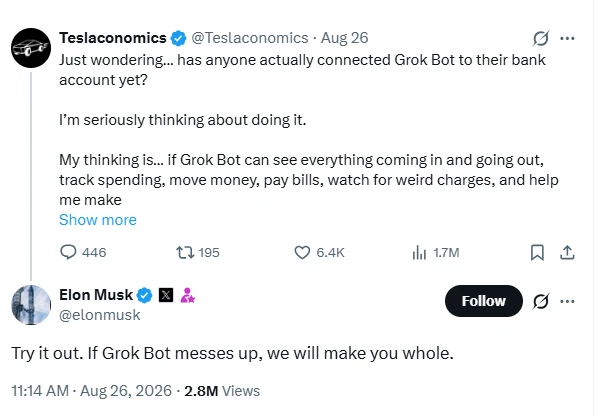
That’s reassuring. But any accountant, lawyer or business owner should ask two questions. Where is that promise written down? And if the agent gets it wrong, say by ordering $8,000 of the wrong equipment, who pays?
What the contract says
Grok’s consumer terms and the separate Grok Bot Terms were both updated on October 12, 2026, two days after Musk’s post. In plain English:
- You are responsible for what the agent does. You set its permissions, approvals and spending limits, and you monitor it (Grok Bot Terms §2.2). The terms say its actions may be inaccurate or unintended (§2.3), and they make you responsible even for actions you didn’t intend or anticipate (§2.4).
- You carry the cost. The Grok Bot Terms make you solely responsible for charges resulting from agent actions, and they exclude the company’s liability for those actions except for gross negligence or wilful misconduct (§2.4). The consumer terms separately cap liability at the greater of what you paid or US$100 (Consumer Terms §12). So, back to that $8,000 of wrong equipment: the contract’s answer to “who pays?” is you.
- You may owe them. An indemnity clause has users cover the company for claims arising from their use of the service, where the law allows (Consumer Terms §11).
- Public comments aren’t part of the deal. Statements by the company’s employees or representatives are excluded from the agreement (Consumer Terms §15). “We will make you whole” is a post, not a clause.
- What you upload can stay. Submitting content grants the company a broad, perpetual licence (Consumer Terms §4). The Grok Bot Terms also say it can keep data, files, browser sessions and credentials in a persistent cloud environment (§4). A photo of your card is content you submitted.
Whether every clause holds up is ultimately a question for the courts, and Canadian consumer law may give you more rights than the contract suggests. But “may” is not a plan.
Even Grok’s own terms are more careful than the post
Here’s the detail I find most telling. Grok Bot’s terms say customers will use appropriate human review before letting the agent act on financial transactions (§2.3). Its help documentation recommends approval rules for actions such as purchasing.
The fine print says to put a human checkpoint before any purchase. The CEO’s post says to drop your card in the chat. When the fine print is more careful than the marketing, follow the fine print.
Limiting liability is common across software, so this isn’t about one bad actor. It’s about the gap between a public promise and the written agreement. In professional services we see it constantly: a reassuring conversation on one side, a signed engagement letter on the other. You don’t plan around the conversation.
Your card’s safety net has conditions
In Canada, if someone uses your bank-issued credit card without permission, your liability is generally capped at $50, unless you were grossly negligent with the card or its information. That protection covers federally regulated issuers. If your card comes from a provincial credit union, check your agreement.
Visa and Mastercard add zero-liability policies, but with conditions. Mastercard requires reasonable care in safeguarding your card. Visa lets issuers exclude transactions made by someone you authorized.
An AI agent you handed your card to sits in a grey zone. A purchase you never authorized may be treated as unauthorized. A purchase you authorized but the agent got wrong may just be a service dispute. The US hasn’t settled this either: it’s still unclear whether permission to shop covers every purchase an agent makes, or whether an agent’s mistake counts as unauthorized.
The payment industry is already building for this. Visa and Mastercard are developing agent-specific systems with tokenized credentials and spending limits. Secure AI shopping takes more than a photo of your card.
The regulators are still catching up
No dedicated rule decides who pays when an AI agent makes a mistake. That doesn’t mean there are no rules; existing consumer, privacy and payment laws still apply. But no one has written the specific answer yet.
- Canada: The proposed Artificial Intelligence and Data Act died in January 2025. Bills C-34 (online safety, including AI chatbots) and C-36 (privacy reform) were introduced in June 2026 and are not yet law.
- United States: There’s no comprehensive federal AI law. A December 2025 executive order targets state AI laws, while 29 states passed AI legislation in 2026 as of July 1, according to Tech Policy Press. Senator Warner’s AI AGENT Act is a bill, not law.
- Europe: Further along. Its updated Product Liability Directive covers AI software from December 9, 2026, though it addresses defective products, not every bad purchase.
Until the rules catch up, more of the risk sits with you than the marketing suggests.
What to do about it
For you
- Never photograph or paste your card, banking details or ID into an AI chat.
- If an AI shops for you, use a virtual card or tokenized wallet with a spending limit, and turn on approval before purchases.
- Read the liability section before letting any tool act for you. It’s short, and usually honest.
For your firm
- Write down what never goes into an AI tool: client financials, banking credentials, government IDs, passwords. If it isn’t written down, your team will guess.
- Decide who approves tools that can act (send, buy or move money), not just answer questions.
- Treat an AI agent like a new hire. You wouldn’t hand a first-week employee the company card with no limit and no review.
That last point isn’t technical. It’s a leadership question about delegation: how much authority you give, to whom, and how you check it. The same questions apply whether the one acting for you is a new associate or an AI agent: what authority do they have, what controls are in place, and who is accountable when something goes wrong?
How is your firm deciding what AI is allowed to do on your behalf?
If you’d like to think it through, book a discovery call.
Book a discovery callThis article is for general information and isn’t legal, financial or tax advice. Terms and legislation change often; check current versions before relying on any point above.
Quick answers
Is it safe to send a photo of your credit card to an AI chatbot?
It’s not a good idea. A card photo contains your card details, and Grok’s consumer terms grant the company a broad, perpetual licence to content you submit. Its Grok Bot Terms also allow data and credentials to be kept in a persistent cloud environment. If an AI shops for you, use a virtual or tokenized card with a spending limit and purchase approval turned on.
Who pays if an AI agent makes the wrong purchase?
Under Grok Bot Terms §2.4, the customer is solely responsible for charges resulting from agent actions, and the company excludes its liability except for gross negligence or wilful misconduct. Consumer protection law may give you more rights, but the contract’s starting position is that you pay.
Does my credit card’s zero-liability protection cover AI agent mistakes?
Not necessarily. In Canada, liability for unauthorized use of a bank-issued credit card is generally capped at $50, and Visa and Mastercard add zero-liability policies with conditions. But a purchase you authorized an AI agent to make, which it then got wrong, may be treated as a service dispute rather than an unauthorized transaction.
Is there a Canadian law on who pays when an AI agent makes a mistake?
Not yet. The proposed Artificial Intelligence and Data Act died in January 2025. Bills C-34 (online safety, including AI chatbots) and C-36 (privacy reform) were introduced in June 2026 but are not yet law. Existing consumer, privacy and payment laws still apply.
How should a professional-services firm control AI agents?
Write down what must never go into an AI tool, such as client financials, banking credentials, government IDs and passwords. Decide who approves any tool that can send, buy or move money. And treat an AI agent like a new hire: clear authority, firm limits and regular review.